01
What the amperage actually means
Your main breaker rating — 100, 125, 150, 200, or 400 amps — is the total amount of electricity your home can safely draw at once. Every appliance and circuit shares that budget.
A 100-amp panel was plenty when homes had gas heat, a gas range, and a gas dryer. Today's homes increasingly run on electricity — EV chargers, heat pumps, induction ranges, and AC — and that budget fills up fast.
02
How to check what you have
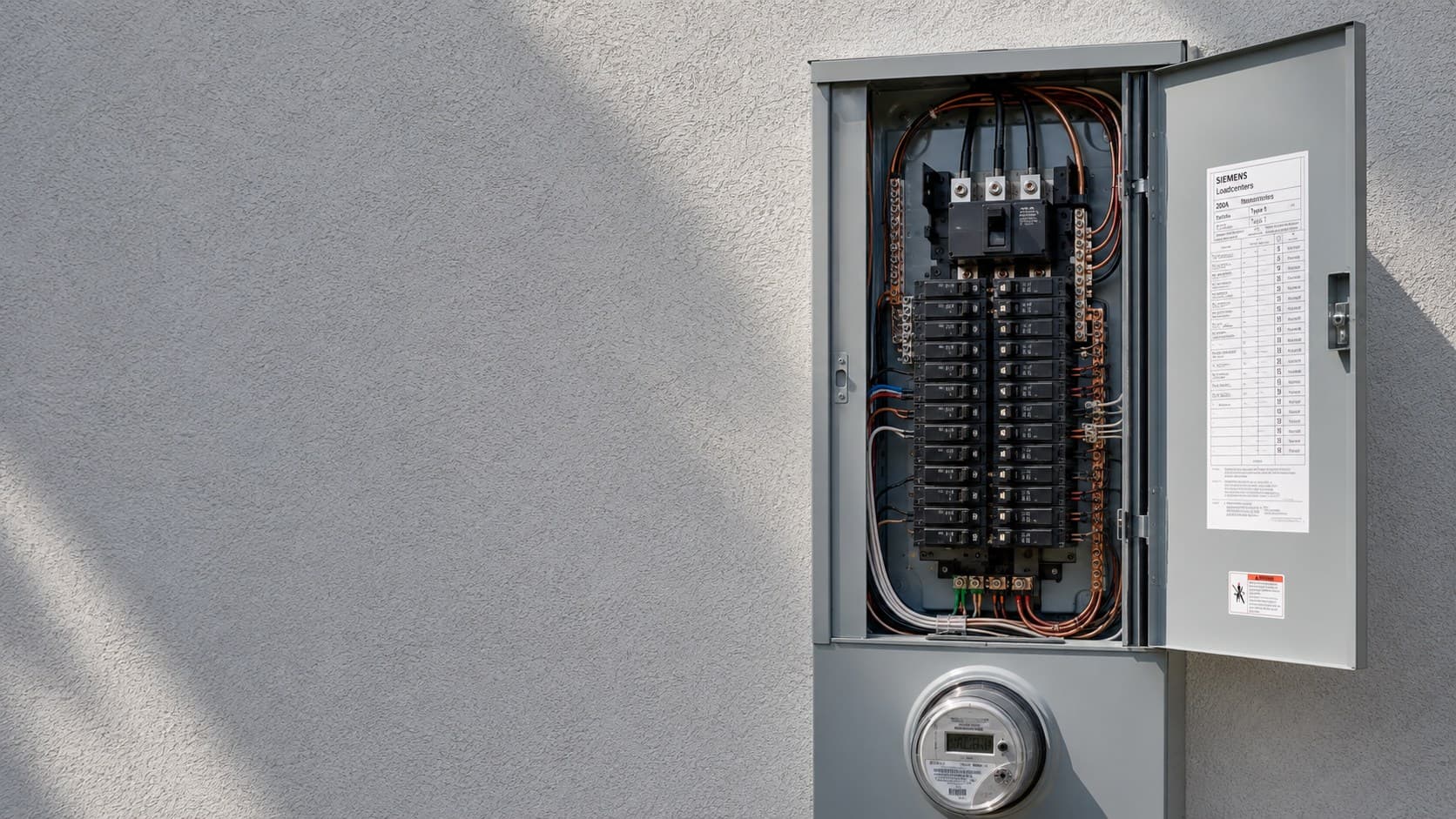
Open your electrical panel door and read the number printed on the large main breaker, usually at the top. It will say 100, 150, 200, etc. If you can't find it, take a photo and send it to us — we'll tell you.
03
What 100-amp service can (and can't) handle
- Usually fine: a smaller home with gas heat/range/dryer and standard outlets and lighting.
- Gets tight: adding central AC, an electric range, or an electric dryer.
- Often too much: adding a Level 2 EV charger on top of the above.
- A red flag: breakers tripping when several big appliances run together.
04
Why 200-amp is the modern standard
A 200-amp panel roughly doubles your capacity and your number of circuit slots. It comfortably supports an EV charger, AC, electric appliances, and solar — with room left for whatever you add next.
For most homeowners planning to electrify (EV, heat pump, induction), 200A is the practical floor. Larger homes, ADUs, or multiple EVs sometimes warrant 400A service.
Not sure if you need to upgrade? A quick load calculation tells you for certain — and sometimes a load-management device lets you add a charger without a full upgrade. We check both for free.
Official sources
Common questions
Before you decide.
Can I run an EV charger on 100-amp service?+
Sometimes — if the panel has spare capacity, or with a load-management device that throttles the charger when other loads spike. Often, though, a 100-amp home needs an upgrade to add a charger safely.
Is 200 amps enough for an EV plus everything else?+
For the vast majority of single-family homes, yes — 200A comfortably handles an EV charger alongside AC, electric appliances, and solar.
Does upgrading my service require SDG&E?+
Changing your service size or moving your meter typically requires coordination with SDG&E (a disconnect/reconnect and a work order). A like-for-like panel swap usually does not. We handle the coordination either way.